
Armor, Inc.
  • Industry
          • Additives and Raw Materials
          • Building Construction and Materials
          • Commercial Roofing
          • Food, Beverage and Pharmaceutical
          • Industrial Maintenance
          • Infrastructure
          • Petrochemical
          • Power
          • Transportation

        • Additives

          Base Emulsions

          Base Cutbacks

          Dampproofing and Waterproofing

          Cooling Towers and HVAC

          Concrete Protection

          Commercial Roofing

          Concrete Repair

          Chemical Resistant Flooring

          Manufactured Housing

          Adhesives

          Structural Steel

          Additives

          Modified Bitumen Components

          Roof Restoration

          Conductive Flooring

          Chemical/Abrasion Resistant Linings

          Chemical Resistant Tiling Systems

          Penetrating Primers For Green and Damp Concrete

          General Corrosion Protection

          Pipe and Leak Repair

          Concrete Protection

          Concrete Repair

          Metal Repair

          Metal Treatment

          Pumps

          Mining

          Pulp and Paper

          Tank Linings

          Structural Steel

          Flooring

          Bridge and Highway

          Concrete Protection

          Concrete Repair

          Pipe and Fittings

          Water/Wastewater

          Chemical Process and Refinery

          Concrete Protection

          Concrete Repair

          Oilfield

          Offshore Drilling

          Pipeline

          Tanks

          Chimney and Duct Linings

          Waste to Fuel/Waste Incineration

          Concrete Protection

          Pipe and Leak Repair

          Concrete Repair

          Cooling Towers

          Absorber/Scrubber

          Automotive, Truck and Bus

          Rail

          RV

          Trailer
  • Products
    • Novocoat
      Ertech
      Blackhawk
      Corrosion Engineering

      Novocoat’s coating solutions emerged out of America’s growing concern for the environment. As a result, Novocoat has developed carefully engineered, 100% solids coating products that provide better and broader-based protection than conventional products, are easy to apply and safe for the user as well as the environment.

      Products

      • Novocoat™ DTM Epoxy
      • Novocoat™ EP3300 Pas...
      • Novocoat™ EP3300 Pas...
      • Novocoat™ EP3700FG C...
      • Novocoat™ EP3800 Cer...
      • Novocoat™ EP3800 Cer...
      • Novocoat™ EP3900 Mac...
      • Novocoat™ EP4900 Cer...
      • Novocoat™ EP5700 Cer...
      • Novocoat™ ER1000 Ela...
      • Novocoat™ HF1200 Epo...
      • Novocoat™ Novofloor
      • Novocoat™ R1900 Quic...
      • Novocoat™ SC1100 Pri...
      • Novocoat™ SC1100 Pri...
      • Novocoat™ SC2200 Rap...
      • Novocoat™ SC3100 HT ...
      • Novocoat™ SC3300 Nov...
      • Novocoat™ SC3300-50 ...
      • Novocoat™ SC3900 Adh...
      • Novocoat™ SC5400 Lin...
      • Novocoat™ SC6300 Epo...
      • Novocoat™ SG2500 HB ...
      • See All Products

      Ertech products provide solutions from below the ground to rooftop. Ertech’s asphaltic emulsions, being water based, are meeting the demands of various markets looking for environmentally and worker friendly solutions to their industrial coating needs.

      Products

      • Ertech™ 2000
      • Ertech™ 2010
      • Ertech™ 2030
      • Ertech™ 2031 LV
      • Ertech™ 2032
      • Ertech™ 2034
      • Ertech™ 2037
      • Ertech™ 2038
      • Ertech™ 2063
      • Ertech™ 2100
      • Ertech™ 2110
      • Ertech™ 2120
      • Ertech™ 3035
      • Ertech™ 3036
      • Ertech™ 3037
      • Ertech™ 3135
      • Ertech™ 3137
      • Ertech™ 7365
      • Ertech™ 8230
      • Ertech™ BGA
      • See All Products

      Armor’s Blackhawk products are manufactured in a state of the art 55,000-square-foot facility centrally located in Kansas City, KS. Blackhawk products are predominately solvated asphalt cutbacks modified further to meet specifications for a variety of adhesives and sealant applications, from foundation waterproofing to commercial roofing.

      Products

      • Blackhawk™ 5011 Liqu...
      • Blackhawk™ 5012 Liqu...
      • Blackhawk™ 5103 SP A...
      • Blackhawk™ 5114 Low-...
      • Blackhawk™ 5159 Asph...
      • Blackhawk™ 5164 Asph...
      • Blackhawk™ 5164 Chas...
      • Blackhawk™ 5200 Gel ...
      • Blackhawk™ 5330 Roof...
      • Blackhawk™ 5360 Roof...
      • Blackhawk™ 5400 Flas...
      • Blackhawk™ 5401 Pipe...
      • Blackhawk™ 5404 Rubb...
      • Blackhawk™ 5405 Wet/...
      • Blackhawk™ 5500 Seal...
      • Blackhawk™ 5501 Roof...
      • Blackhawk™ 5510 Seal...
      • Blackhawk™ 5600 Seal...
      • Blackhawk™ 5700 Memb...
      • Blackhawk™ 5710 Memb...
      • Blackhawk™ 5715 Seal...
      • Blackhawk™ 5720 Memb...
      • Blackhawk™ 5900 Seri...
      • See All Products

      Industries that use or produce corrosive or hazardous chemicals are challenged to maintain safe and reliable facilities while preserving the environment. Since the mid-1900’s, factory owners put their trust in acid brick linings, constructed with Corrosion Engineering™ chemical-resistant mortars and membranes, to help them achieve these goals.

      Products

      • ACROCAST™ Concrete
      • ACROCAST™ Grout
      • ACROCAST™ XF Concret...
      • ACROCAST™ XF Grout
      • ACROLINE™ Systems
      • Armor™ Graphite Tile
      • ASPLIT™ CN Mortar
      • ASPLIT™ Special Mort...
      • CORLOK™ B Mortar
      • Epoxy Cold Room Hard...
      • FLEXJOINT™ 700 Topco...
      • FLEXJOINT™ Joint Sea...
      • FLEXJOINT™ U500 Seal...
      • FURALAC™ FN Mortar
      • FURALAC™ Green Panel...
      • FURALAC™ Membrane
      • FURALAC™ Red Panel G...
      • HB™ Mortar
      • HES™ Cement
      • K14™ Mortar
      • PACMASTIC™ 325 Membr...
      • PC1000™ Mortar
      • PENNCHEM™ 97 Membran...
      • See All Products
  • Resources
    • Product Data Sheets
    • Safety Data Sheets
    • Installation Guidance
    • Brochures
    • Project Profiles
    • Detail Drawings
    • Chemical Resistance
    • White Papers
  • About
  • Contact
  • Click to open the search input field Click to open the search input field Search
  • Menu Menu
Search Search

Seal Sewer Structures Securely with HDPE

I’m sure this has never happened anywhere you’ve worked, but have you heard of a friend of a friend, who discovered that their plant process sewers were leaking? Sewers can be a major drain on maintenance budgets when they go bad. Bypass-pumping costs can add up and, for some reason, despite this cost, no one seems anxious to dig up pipes and fix them. What if they discover that the soil is contaminated? Again, we’re not talking about anywhere you have worked, but maybe somewhere your cousin’s neighbor’s kid used to work. Read on to learn how high-density polyethylene (HDPE) can seal sewer structures securely.

High-density polyethylene has gained favor as a material of construction for chemical process sewers. It offers broad chemical resistance and lends itself to a variety of installation techniques from open cut construction to trenchless technologies like slip-lining, pipe bursting, directional drilling, and fold-and-form relining. There are lots of ways to get HDPE into your sewers and eliminate the old segmented concrete or vitreous clay leakers, but what about the manholes and lift stations?

To achieve a bottle-tight sewer—and keep sewers off the environmental manager’s radar—sewer appurtenances can be likewise lined with HDPE, avoiding dissimilar material interfaces and leaky mechanical seals between pipes and pits. Anchored thermoplastic liners, available in HDPE, as well as polypropylene, polyvinylidene fluoride, and ethylene and chlorortrifluoroethylene copolymer, can be used to line the insides of concrete forms to seal cast-in-place or precast structures.

Using these HDPE liners in conjunction with HDPE pipe or pipe liners enables the two to be welded together for a permanent, bottle-tight seal. And, when properly specified and installed, anchored HDPE liners can be reasonably expected to outperform coating alternatives.
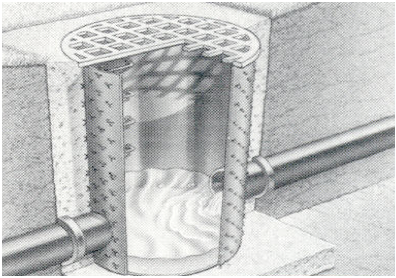
Screen Shot 2013 02 20 at 3.48.53 PM

Safely Sealed – Flanged or unflanged HDPE pipe stub-outs can be welded to HDPE manhole liners for a leak-tight connection.

Top 5 Advantages of Anchored HDPE Liners over Concrete Coatings

  1. Longer expected service life
  2. Resistant to hydrostatic groundwater backpressure/delamination
  3. Suitable for installation during cold to very hot weather
  4. Can be prefabricated, precast to save construction time
  5. Can be welded to inlet pipes, trenches for leak-tight seal

1. Longer expected service life

In the chemical industry, a service life of greater than 25 years is attributed to anchored HDPE liners. Common causes of premature failure are temperature excursions during periods of high groundwater and changes in the effluent chemistry. Poor quality installation techniques—incomplete consolidation of the concrete or grout behind the liner, nail holes left from the formwork—could also lead to premature failure. To mitigate temperature related failures, designers must be mindful of the potential for steam or steam condensate to discharge into the sewer system, either in large volume or into an empty sewer in small but continuous volumes. Engineering controls, such as a quench system or retention pit, could be employed to cool hot effluent streams.

2. Resistant to hydrostatic groundwater backpressure/delamination

Before liquid coatings are applied to concrete sewer structures, the concrete is cleaned and abraded or etched to create a surface profile, increasing the surface area to which the coating might adhere. Chemical contamination, moisture, or inadequate profile can interfere with the coating’s adhesion. Add hydrostatic backpressure to a marginally bonded coating, and the coating will likely delaminate or crack.

Anchored HDPE liners do not rely on this type of surface adhesion. The liners are mechanically locked into the concrete surface by means of numerous anchors formed into one side of the liner during manufacture. This mechanical interlocking provides excellent resistance to hydrostatic backpressure while minimizing deformation of the liner as temperatures fluctuate.

3. Suitable for cold and very hot weather installation

Most liquid-applied coatings require strict adherence to temperature and humidity limitations during application to reach full cure. Coatings tolerant of temperatures below 50 or 60°F offer limited chemical resistance and moisture tolerance. The same coatings might react too quickly for practical use over 80 or 85°F.

HDPE liners are an extruded sheet product and do not cure in the field, enabling their use in very cold and very hot weather. However, welding operations are sensitive to moisture. Humidity levels and dew points need to be monitored when the liners are being welded.

4. Can be prefabricated, precast to save construction time

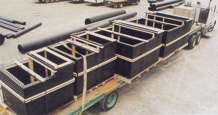
Prefabricating or pre-casting the HDPE liners can save field construction time and avoid variable site conditions during welding and concrete casting operations, respectively. Smaller structures such as manhole sections, trench segments, and sump boxes are most conducive to prefabrication and pre-casting, though large tanks have been successfully pre-cast in sections.
what

Load ‘em Up, Move ‘em Out! – Prefabricating liners small enough to fit on a flatbed truck can save construction time and keep transportation costs under control.

5. Can be welded to inlet pipes, trenches for leak-tight seal

Inlet pipes and trenches lined with HDPE can be welded to lift stations and manholes lined with HDPE, provided the grades of HDPE are compatible. In contrast, a coated concrete manhole or lift station couldn’t be welded to plastic sewer pipes. The leak-tightness of such an interface would depend upon a mechanical coupling, and the risk associated with these out-of-sight, out-of-mind fittings leaking underground is not terribly attractive.

Anchored HDPE liners do not rely on this type of surface adhesion. The liners are mechanically locked into the concrete surface by means of numerous anchors formed into one side of the liner during manufacture. This mechanical interlocking provides excellent resistance to hydrostatic backpressure while minimizing deformation of the liner as temperatures fluctuate.

Conclusion

There are good reasons to use anchored HDPE liners instead of coatings in sewer manholes and lift stations—longevity, groundwater resistance, installation weather tolerance, construction time savings, and weldable pipe connections. For optimal design, the sewer pipes and appurtenances are best considered together, not just as a means of getting wastewater from point A to point B, but as integral components of a critical containment system.

Follow Us:


Our Products

  • Blackhawk
  • Corrosion Engineering
  • Ertech
  • Novocoat
  • Manufacturing Services
  • Sumter Coatings
  • Quality, Health and Safety Policy
  • Terms & Conditions

Contact Us

Contact Us - Armor
© 2026. All Right Reserved. Armor, Inc.
  • Home
  • Industry
  • Products
  • Resources
  • News
  • About
  • Contact
Scroll to top Scroll to top Scroll to top