
Armor, Inc.
  • Industry
          • Additives and Raw Materials
          • Building Construction and Materials
          • Commercial Roofing
          • Food, Beverage and Pharmaceutical
          • Industrial Maintenance
          • Infrastructure
          • Petrochemical
          • Power
          • Transportation

        • Additives

          Base Emulsions

          Base Cutbacks

          Dampproofing and Waterproofing

          Cooling Towers and HVAC

          Concrete Protection

          Commercial Roofing

          Concrete Repair

          Chemical Resistant Flooring

          Manufactured Housing

          Adhesives

          Structural Steel

          Additives

          Modified Bitumen Components

          Roof Restoration

          Conductive Flooring

          Chemical/Abrasion Resistant Linings

          Chemical Resistant Tiling Systems

          Penetrating Primers For Green and Damp Concrete

          General Corrosion Protection

          Pipe and Leak Repair

          Concrete Protection

          Concrete Repair

          Metal Repair

          Metal Treatment

          Pumps

          Mining

          Pulp and Paper

          Tank Linings

          Structural Steel

          Flooring

          Bridge and Highway

          Concrete Protection

          Concrete Repair

          Pipe and Fittings

          Water/Wastewater

          Chemical Process and Refinery

          Concrete Protection

          Concrete Repair

          Oilfield

          Offshore Drilling

          Pipeline

          Tanks

          Chimney and Duct Linings

          Waste to Fuel/Waste Incineration

          Concrete Protection

          Pipe and Leak Repair

          Concrete Repair

          Cooling Towers

          Absorber/Scrubber

          Automotive, Truck and Bus

          Rail

          RV

          Trailer
  • Products
    • Novocoat
      Ertech
      Blackhawk
      Corrosion Engineering

      Novocoat’s coating solutions emerged out of America’s growing concern for the environment. As a result, Novocoat has developed carefully engineered, 100% solids coating products that provide better and broader-based protection than conventional products, are easy to apply and safe for the user as well as the environment.

      Products

      • Novocoat™ DTM Epoxy
      • Novocoat™ EP3300 Pas...
      • Novocoat™ EP3300 Pas...
      • Novocoat™ EP3700FG C...
      • Novocoat™ EP3800 Cer...
      • Novocoat™ EP3800 Cer...
      • Novocoat™ EP3900 Mac...
      • Novocoat™ EP4900 Cer...
      • Novocoat™ EP5700 Cer...
      • Novocoat™ ER1000 Ela...
      • Novocoat™ HF1200 Epo...
      • Novocoat™ Novofloor
      • Novocoat™ R1900 Quic...
      • Novocoat™ SC1100 Pri...
      • Novocoat™ SC1100 Pri...
      • Novocoat™ SC2200 Rap...
      • Novocoat™ SC3100 HT ...
      • Novocoat™ SC3300 Nov...
      • Novocoat™ SC3300-50 ...
      • Novocoat™ SC3900 Adh...
      • Novocoat™ SC5400 Lin...
      • Novocoat™ SC6300 Epo...
      • Novocoat™ SG2500 HB ...
      • See All Products

      Ertech products provide solutions from below the ground to rooftop. Ertech’s asphaltic emulsions, being water based, are meeting the demands of various markets looking for environmentally and worker friendly solutions to their industrial coating needs.

      Products

      • Ertech™ 2000
      • Ertech™ 2010
      • Ertech™ 2030
      • Ertech™ 2031 LV
      • Ertech™ 2032
      • Ertech™ 2034
      • Ertech™ 2037
      • Ertech™ 2038
      • Ertech™ 2063
      • Ertech™ 2100
      • Ertech™ 2110
      • Ertech™ 2120
      • Ertech™ 3035
      • Ertech™ 3036
      • Ertech™ 3037
      • Ertech™ 3135
      • Ertech™ 3137
      • Ertech™ 7365
      • Ertech™ 8230
      • Ertech™ BGA
      • See All Products

      Armor’s Blackhawk products are manufactured in a state of the art 55,000-square-foot facility centrally located in Kansas City, KS. Blackhawk products are predominately solvated asphalt cutbacks modified further to meet specifications for a variety of adhesives and sealant applications, from foundation waterproofing to commercial roofing.

      Products

      • Blackhawk™ 5011 Liqu...
      • Blackhawk™ 5012 Liqu...
      • Blackhawk™ 5103 SP A...
      • Blackhawk™ 5114 Low-...
      • Blackhawk™ 5159 Asph...
      • Blackhawk™ 5164 Asph...
      • Blackhawk™ 5164 Chas...
      • Blackhawk™ 5200 Gel ...
      • Blackhawk™ 5330 Roof...
      • Blackhawk™ 5360 Roof...
      • Blackhawk™ 5400 Flas...
      • Blackhawk™ 5401 Pipe...
      • Blackhawk™ 5404 Rubb...
      • Blackhawk™ 5405 Wet/...
      • Blackhawk™ 5500 Seal...
      • Blackhawk™ 5501 Roof...
      • Blackhawk™ 5510 Seal...
      • Blackhawk™ 5600 Seal...
      • Blackhawk™ 5700 Memb...
      • Blackhawk™ 5710 Memb...
      • Blackhawk™ 5715 Seal...
      • Blackhawk™ 5720 Memb...
      • Blackhawk™ 5900 Seri...
      • See All Products

      Industries that use or produce corrosive or hazardous chemicals are challenged to maintain safe and reliable facilities while preserving the environment. Since the mid-1900’s, factory owners put their trust in acid brick linings, constructed with Corrosion Engineering™ chemical-resistant mortars and membranes, to help them achieve these goals.

      Products

      • ACROCAST™ Concrete
      • ACROCAST™ Grout
      • ACROCAST™ XF Concret...
      • ACROCAST™ XF Grout
      • ACROLINE™ Systems
      • Armor™ Graphite Tile
      • ASPLIT™ CN Mortar
      • ASPLIT™ Special Mort...
      • CORLOK™ B Mortar
      • Epoxy Cold Room Hard...
      • FLEXJOINT™ 700 Topco...
      • FLEXJOINT™ Joint Sea...
      • FLEXJOINT™ U500 Seal...
      • FURALAC™ FN Mortar
      • FURALAC™ Green Panel...
      • FURALAC™ Membrane
      • FURALAC™ Red Panel G...
      • HB™ Mortar
      • HES™ Cement
      • K14™ Mortar
      • PACMASTIC™ 325 Membr...
      • PC1000™ Mortar
      • PENNCHEM™ 97 Membran...
      • See All Products
  • Resources
    • Product Data Sheets
    • Safety Data Sheets
    • Installation Guidance
    • Brochures
    • Project Profiles
    • Detail Drawings
    • Chemical Resistance
    • White Papers
  • About
  • Contact
  • Click to open the search input field Click to open the search input field Search
  • Menu Menu
Search Search

Are Worn Trowels Ruining Your Tile Jobs?

How many notched trowels do you go though on a typical thin-set tile job? It might not be enough.
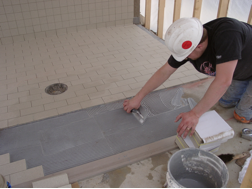
thinAccording to the National Tile Contractors Association website glossary, the term “thin-set” is used to describe the bonding of tile with suitable materials applied at about 1/8″ (3 mm) thick. These “suitable materials” might be, among others, latex or epoxy-based adhesive, though epoxy is favored for industrial tiling.

“Thin-set adhesive” is also a generic term used to describe tile adhesive applied at about 1/8” (3 mm). This generic term should not be confused with THINSET® brand tile adhesives, which are 100% solids, epoxy-based, thin-set adhesives marketed by Henkel Technologies.

The adhesive application tool of choice is the 1/4″ x 1/4″ (6 mm x 6 mm) notched trowel.

A notched trowel is a flat trowel with serrated edges. A 1/4″ x 1/4″ notched trowel will have 1/4″ gaps between the points of the teeth.

If you looked at the triangle-shaped spaces between the teeth, they would all have 1/4″ base length and 1/4″ height—1/4″ x 1/4″. With use the points on notched trowels get worn. As the points wear down, the thickness of adhesive the trowel leaves on the concrete dwindles.

This little math exercise might explain why theoretical adhesive consumption estimates are often greater than actual consumption. It will also show you how tool wear can really mess up a tile floor.

If you recall your high school geometry, you will remember that the area of a triangle is calculated by multiplying ½ times the base length and the height:

T = ½ bh, where T is the area of the triangle
b is the base length
h is the height

The area of each gap between the teeth on a new 1/4″ x 1/4″ notched trowel is

T = 1/2(1/4″)(1/4″), or 0.031 in2

Remember that the objective is to apply a uniform 1/8″ thick setting bed. When you spread adhesive with a notched trowel then flatten all of these little 1/4″ high triangles, you get a bunch of 1/8″ high rectangles side-by-side—a nice, uniform 1/8″ thick setting bed. We can prove this by calculating the area of a rectangle that is 1/8″ wide (equal to the desired setting bed thickness) and 1/4″ long (equal to the length of the base of the triangular notches).

R = bt, where R is the area of the rectangle
b is the length
t is the width

R = (1/4″)(1/8″), or 0.031 in2

The area of this 1/8″ tall rectangle is equal to the area of our 1/4″ tall right triangle. This is why you get a uniform 1/8″ setting bed with a new 1/4″ x 1/4″ notched trowel.

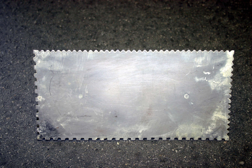
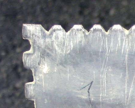
What happens when the tips start to wear off as has happened along the top edge of the trowel shown below?
thin2

thin3

Let’s say you wear about 1/32″ off the tips of your notched trowel. Now the height of the gaps between the teeth is only 7/32″

h2 = h1 – w, where h2 is the new notch height
h1 is the original height
w is the wear
h2 = 1/4″-1/32″, or 7/32″

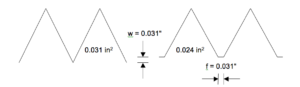
The length of the gaps between the teeth will shrink from 1/4″ (0.25″) to 0.22″. And now, where there used to be a point, there is a flat stretch (f) 0.031″ long between each notch that drags the concrete.
Screen Shot 2013 02 20 at 3.18.32 PM

Wearing down the points makes the area of the notches smaller. 1/32″ of wear translates to a notch area 0.024 in2. Even though the base of the triangle-shaped notches gets smaller, the spacing of the notches hasn’t changed. To figure out how this change in the shape of the teeth affects the thickness of the adhesive bed, we have to calculate the height of a rectangle with equivalent area, using the original rectangle length of 1/4″.

t = R / b, where R is the area of the rectangle
b is the length
t is the width

t = 0.024 in2 / 0.25″, or 0.096″

So, instead of a 1/8″ (0.125″) setting bed, the setting bed will be 0.096″ thick. This means that a 12.5% loss of notch height—1/32″ off of 1/4″—results in a 23% reduction in setting be thickness. If we double that wear to 1/16″, the membrane thickness is only 56% of the desired thickness (1/8″).

A little bit of notch wear can lead to a big loss of adhesive thickness. Monitor tool wear to make sure the points on your notched trowels are sharp, and replace them as needed. A drop in adhesive consumption rates might also indicate tool wear problems, but a problem with one laborer’s trowel could get lost in the average adhesive consumption of the crew. It’s best to inspect individual hand tools routinely and toss the old ones to avoid problems.

Industrial tile flooring performance depends upon many factors including the use of good quality adhesive, thorough surface preparation, and use of strong substrate materials. The more contact surface area between the tiles and adhesive, the better the tiles will resist impact loads and thermal shock. If there is not enough adhesive on the substrate during installation, performance problems such as cracked or disbonded tiles are sure to follow.

Follow Us:


Our Products

  • Blackhawk
  • Corrosion Engineering
  • Ertech
  • Novocoat
  • Manufacturing Services
  • Sumter Coatings
  • Quality, Health and Safety Policy
  • Terms & Conditions

Contact Us

Contact Us - Armor
© 2026. All Right Reserved. Armor, Inc.
  • Home
  • Industry
  • Products
  • Resources
  • News
  • About
  • Contact
Scroll to top Scroll to top Scroll to top