
Armor, Inc.
  • Industry
          • Additives and Raw Materials
          • Building Construction and Materials
          • Commercial Roofing
          • Food, Beverage and Pharmaceutical
          • Industrial Maintenance
          • Infrastructure
          • Petrochemical
          • Power
          • Transportation

        • Additives

          Base Emulsions

          Base Cutbacks

          Dampproofing and Waterproofing

          Cooling Towers and HVAC

          Concrete Protection

          Commercial Roofing

          Concrete Repair

          Chemical Resistant Flooring

          Manufactured Housing

          Adhesives

          Structural Steel

          Additives

          Modified Bitumen Components

          Roof Restoration

          Conductive Flooring

          Chemical/Abrasion Resistant Linings

          Chemical Resistant Tiling Systems

          Penetrating Primers For Green and Damp Concrete

          General Corrosion Protection

          Pipe and Leak Repair

          Concrete Protection

          Concrete Repair

          Metal Repair

          Metal Treatment

          Pumps

          Mining

          Pulp and Paper

          Tank Linings

          Structural Steel

          Flooring

          Bridge and Highway

          Concrete Protection

          Concrete Repair

          Pipe and Fittings

          Water/Wastewater

          Chemical Process and Refinery

          Concrete Protection

          Concrete Repair

          Oilfield

          Offshore Drilling

          Pipeline

          Tanks

          Chimney and Duct Linings

          Waste to Fuel/Waste Incineration

          Concrete Protection

          Pipe and Leak Repair

          Concrete Repair

          Cooling Towers

          Absorber/Scrubber

          Automotive, Truck and Bus

          Rail

          RV

          Trailer
  • Products
    • Novocoat
      Ertech
      Blackhawk
      Corrosion Engineering

      Novocoat’s coating solutions emerged out of America’s growing concern for the environment. As a result, Novocoat has developed carefully engineered, 100% solids coating products that provide better and broader-based protection than conventional products, are easy to apply and safe for the user as well as the environment.

      Products

      • Novocoat™ DTM Epoxy
      • Novocoat™ EP3300 Pas...
      • Novocoat™ EP3300 Pas...
      • Novocoat™ EP3700FG C...
      • Novocoat™ EP3800 Cer...
      • Novocoat™ EP3800 Cer...
      • Novocoat™ EP3900 Mac...
      • Novocoat™ EP4900 Cer...
      • Novocoat™ EP5700 Cer...
      • Novocoat™ ER1000 Ela...
      • Novocoat™ HF1200 Epo...
      • Novocoat™ Novofloor
      • Novocoat™ R1900 Quic...
      • Novocoat™ SC1100 Pri...
      • Novocoat™ SC1100 Pri...
      • Novocoat™ SC2200 Rap...
      • Novocoat™ SC3100 HT ...
      • Novocoat™ SC3300 Nov...
      • Novocoat™ SC3300-50 ...
      • Novocoat™ SC3900 Adh...
      • Novocoat™ SC5400 Lin...
      • Novocoat™ SC6300 Epo...
      • Novocoat™ SG2500 HB ...
      • See All Products

      Ertech products provide solutions from below the ground to rooftop. Ertech’s asphaltic emulsions, being water based, are meeting the demands of various markets looking for environmentally and worker friendly solutions to their industrial coating needs.

      Products

      • Ertech™ 2000
      • Ertech™ 2010
      • Ertech™ 2030
      • Ertech™ 2031 LV
      • Ertech™ 2032
      • Ertech™ 2034
      • Ertech™ 2037
      • Ertech™ 2038
      • Ertech™ 2063
      • Ertech™ 2100
      • Ertech™ 2110
      • Ertech™ 2120
      • Ertech™ 3035
      • Ertech™ 3036
      • Ertech™ 3037
      • Ertech™ 3135
      • Ertech™ 3137
      • Ertech™ 7365
      • Ertech™ 8230
      • Ertech™ BGA
      • See All Products

      Armor’s Blackhawk products are manufactured in a state of the art 55,000-square-foot facility centrally located in Kansas City, KS. Blackhawk products are predominately solvated asphalt cutbacks modified further to meet specifications for a variety of adhesives and sealant applications, from foundation waterproofing to commercial roofing.

      Products

      • Blackhawk™ 5011 Liqu...
      • Blackhawk™ 5012 Liqu...
      • Blackhawk™ 5103 SP A...
      • Blackhawk™ 5114 Low-...
      • Blackhawk™ 5159 Asph...
      • Blackhawk™ 5164 Asph...
      • Blackhawk™ 5164 Chas...
      • Blackhawk™ 5200 Gel ...
      • Blackhawk™ 5330 Roof...
      • Blackhawk™ 5360 Roof...
      • Blackhawk™ 5400 Flas...
      • Blackhawk™ 5401 Pipe...
      • Blackhawk™ 5404 Rubb...
      • Blackhawk™ 5405 Wet/...
      • Blackhawk™ 5500 Seal...
      • Blackhawk™ 5501 Roof...
      • Blackhawk™ 5510 Seal...
      • Blackhawk™ 5600 Seal...
      • Blackhawk™ 5700 Memb...
      • Blackhawk™ 5710 Memb...
      • Blackhawk™ 5715 Seal...
      • Blackhawk™ 5720 Memb...
      • Blackhawk™ 5900 Seri...
      • See All Products

      Industries that use or produce corrosive or hazardous chemicals are challenged to maintain safe and reliable facilities while preserving the environment. Since the mid-1900’s, factory owners put their trust in acid brick linings, constructed with Corrosion Engineering™ chemical-resistant mortars and membranes, to help them achieve these goals.

      Products

      • ACROCAST™ Concrete
      • ACROCAST™ Grout
      • ACROCAST™ XF Concret...
      • ACROCAST™ XF Grout
      • ACROLINE™ Systems
      • Armor™ Graphite Tile
      • ASPLIT™ CN Mortar
      • ASPLIT™ Special Mort...
      • CORLOK™ B Mortar
      • Epoxy Cold Room Hard...
      • FLEXJOINT™ 700 Topco...
      • FLEXJOINT™ Joint Sea...
      • FLEXJOINT™ U500 Seal...
      • FURALAC™ FN Mortar
      • FURALAC™ Green Panel...
      • FURALAC™ Membrane
      • FURALAC™ Red Panel G...
      • HB™ Mortar
      • HES™ Cement
      • K14™ Mortar
      • PACMASTIC™ 325 Membr...
      • PC1000™ Mortar
      • PENNCHEM™ 97 Membran...
      • See All Products
  • Resources
    • Product Data Sheets
    • Safety Data Sheets
    • Installation Guidance
    • Brochures
    • Project Profiles
    • Detail Drawings
    • Chemical Resistance
    • White Papers
  • About
  • Contact
  • Click to open the search input field Click to open the search input field Search
  • Menu Menu
Search Search

Acid Brick-to-Epoxy Flooring Transition Detail
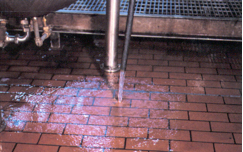
acid1Industrial facilities that handle corrosive chemicals often rely on a variety of protective flooring systems. While epoxy toppings might provide sufficient protection for many areas, acid brick flooring might be the best choice for areas subject to thermal shock or mechanical abuse. To avoid maintenance problems where the two types of flooring meet, engineers must carefully design the transition details.

Let’s consider several possible approaches—a butt joint, a mortared joint, a sealed joint, and an overlap joint.

Butt Joint acid2
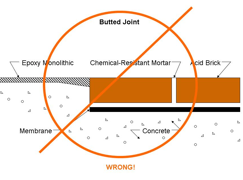
Detail summary: epoxy lining butts into the side of the brick lining, such that the surfaces of both linings are flush.

The problem with this design is that it introduces a discontinuity in the chemical barrier at the interface between the brick lining and epoxy. US-produced, red shale acid bricks are absorbent. In an acid brick lining, the membrane is the chemical barrier. The bricks could transmit corrosive fluids to the substrate under the epoxy through direct contact.

Mortared Joint

Detail summary: epoxy lining butts into a mortared head joint, such that the surfaces of both linings are flush. aicd5
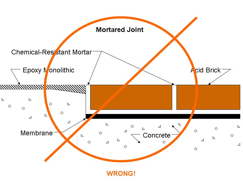
Mortars that use an acid catalyst—furans, phenolics, and potassium silicates—do not reliably adhere to Portland cement concrete. Theoretically, the acid catalyst reacts with the alkaline concrete at the interface, and the neutralization products interfere with adhesion. In effect, there would be a crevice on the epoxy side of the mortar head joint through which fluids could penetrate and attack the substrate under the epoxy topping.

Sealed Joint

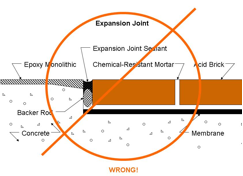
Detail summary: epoxy and acid brick linings do not touch, and the gap is filled with backer rod and sealant.

This detail has the same limitation as the butt joint detail—corrosive fluid can pass from the brick to the substrate under the epoxy. Further, it unnecessarily introduces a weak link into the lining system—joint sealant. Joint sealant typically offers less chemical resistance and durability than epoxy monolithics or acid brick lining systems.

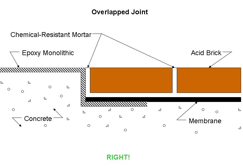
Overlapped Joint

Detail summary: brick membrane overlaps epoxy monolithic at interface, and head joint at interface is mortared. acid3
This detail provides good continuity of the corrosion barrier as it transitions from epoxy monolithic to membrane. Filling the head joint adjacent to the epoxy topping with mortar avoids leaving any gaps between the imperfect surfaces of the bricks and epoxy.

There are several different details an engineer might consider when designing transitions between epoxy monolithic and acid brick flooring systems. In order to select the best acid4 option, the engineer needs to understand the properties and capabilities of the system components.
  • US-produced, red shale acid bricks are absorbent and permeable.
  • In an acid brick lining, the membrane is the chemical barrier.
  • Certain types of chemical-resistant mortar react with Portland cement concrete before they reach full cure, preventing good adhesion between the mortar and concrete.
  • Joint sealant is a weak link in any corrosion protection flooring system in terms of chemical resistance and durability.

With an understanding of these characteristics, an engineer can more effectively design transition details between acid brick linings and monolithic floor toppings.

Follow Us:


Our Products

  • Blackhawk
  • Corrosion Engineering
  • Ertech
  • Novocoat
  • Manufacturing Services
  • Sumter Coatings
  • Quality, Health and Safety Policy
  • Terms & Conditions

Contact Us

Contact Us - Armor
© 2026. All Right Reserved. Armor, Inc.
  • Home
  • Industry
  • Products
  • Resources
  • News
  • About
  • Contact
Scroll to top Scroll to top Scroll to top