
Armor, Inc.
  • Industry
          • Additives and Raw Materials
          • Building Construction and Materials
          • Commercial Roofing
          • Food, Beverage and Pharmaceutical
          • Industrial Maintenance
          • Infrastructure
          • Petrochemical
          • Power
          • Transportation

        • Additives

          Base Emulsions

          Base Cutbacks

          Dampproofing and Waterproofing

          Cooling Towers and HVAC

          Concrete Protection

          Commercial Roofing

          Concrete Repair

          Chemical Resistant Flooring

          Manufactured Housing

          Adhesives

          Structural Steel

          Additives

          Modified Bitumen Components

          Roof Restoration

          Conductive Flooring

          Chemical/Abrasion Resistant Linings

          Chemical Resistant Tiling Systems

          Penetrating Primers For Green and Damp Concrete

          General Corrosion Protection

          Pipe and Leak Repair

          Concrete Protection

          Concrete Repair

          Metal Repair

          Metal Treatment

          Pumps

          Mining

          Pulp and Paper

          Tank Linings

          Structural Steel

          Flooring

          Bridge and Highway

          Concrete Protection

          Concrete Repair

          Pipe and Fittings

          Water/Wastewater

          Chemical Process and Refinery

          Concrete Protection

          Concrete Repair

          Oilfield

          Offshore Drilling

          Pipeline

          Tanks

          Chimney and Duct Linings

          Waste to Fuel/Waste Incineration

          Concrete Protection

          Pipe and Leak Repair

          Concrete Repair

          Cooling Towers

          Absorber/Scrubber

          Automotive, Truck and Bus

          Rail

          RV

          Trailer
  • Products
    • Novocoat
      Ertech
      Blackhawk
      Corrosion Engineering

      Novocoat’s coating solutions emerged out of America’s growing concern for the environment. As a result, Novocoat has developed carefully engineered, 100% solids coating products that provide better and broader-based protection than conventional products, are easy to apply and safe for the user as well as the environment.

      Products

      • Novocoat™ DTM Epoxy
      • Novocoat™ EP3300 Pas...
      • Novocoat™ EP3300 Pas...
      • Novocoat™ EP3700FG C...
      • Novocoat™ EP3800 Cer...
      • Novocoat™ EP3800 Cer...
      • Novocoat™ EP3900 Mac...
      • Novocoat™ EP4900 Cer...
      • Novocoat™ EP5700 Cer...
      • Novocoat™ ER1000 Ela...
      • Novocoat™ HF1200 Epo...
      • Novocoat™ Novofloor
      • Novocoat™ R1900 Quic...
      • Novocoat™ SC1100 Pri...
      • Novocoat™ SC1100 Pri...
      • Novocoat™ SC2200 Rap...
      • Novocoat™ SC3100 HT ...
      • Novocoat™ SC3300 Nov...
      • Novocoat™ SC3300-50 ...
      • Novocoat™ SC3900 Adh...
      • Novocoat™ SC5400 Lin...
      • Novocoat™ SC6300 Epo...
      • Novocoat™ SG2500 HB ...
      • See All Products

      Ertech products provide solutions from below the ground to rooftop. Ertech’s asphaltic emulsions, being water based, are meeting the demands of various markets looking for environmentally and worker friendly solutions to their industrial coating needs.

      Products

      • Ertech™ 2000
      • Ertech™ 2010
      • Ertech™ 2030
      • Ertech™ 2031 LV
      • Ertech™ 2032
      • Ertech™ 2034
      • Ertech™ 2037
      • Ertech™ 2038
      • Ertech™ 2063
      • Ertech™ 2100
      • Ertech™ 2110
      • Ertech™ 2120
      • Ertech™ 3035
      • Ertech™ 3036
      • Ertech™ 3037
      • Ertech™ 3135
      • Ertech™ 3137
      • Ertech™ 7365
      • Ertech™ 8230
      • Ertech™ BGA
      • See All Products

      Armor’s Blackhawk products are manufactured in a state of the art 55,000-square-foot facility centrally located in Kansas City, KS. Blackhawk products are predominately solvated asphalt cutbacks modified further to meet specifications for a variety of adhesives and sealant applications, from foundation waterproofing to commercial roofing.

      Products

      • Blackhawk™ 5011 Liqu...
      • Blackhawk™ 5012 Liqu...
      • Blackhawk™ 5103 SP A...
      • Blackhawk™ 5114 Low-...
      • Blackhawk™ 5159 Asph...
      • Blackhawk™ 5164 Asph...
      • Blackhawk™ 5164 Chas...
      • Blackhawk™ 5200 Gel ...
      • Blackhawk™ 5330 Roof...
      • Blackhawk™ 5360 Roof...
      • Blackhawk™ 5400 Flas...
      • Blackhawk™ 5401 Pipe...
      • Blackhawk™ 5404 Rubb...
      • Blackhawk™ 5405 Wet/...
      • Blackhawk™ 5500 Seal...
      • Blackhawk™ 5501 Roof...
      • Blackhawk™ 5510 Seal...
      • Blackhawk™ 5600 Seal...
      • Blackhawk™ 5700 Memb...
      • Blackhawk™ 5710 Memb...
      • Blackhawk™ 5715 Seal...
      • Blackhawk™ 5720 Memb...
      • Blackhawk™ 5900 Seri...
      • See All Products

      Industries that use or produce corrosive or hazardous chemicals are challenged to maintain safe and reliable facilities while preserving the environment. Since the mid-1900’s, factory owners put their trust in acid brick linings, constructed with Corrosion Engineering™ chemical-resistant mortars and membranes, to help them achieve these goals.

      Products

      • ACROCAST™ Concrete
      • ACROCAST™ Grout
      • ACROCAST™ XF Concret...
      • ACROCAST™ XF Grout
      • ACROLINE™ Systems
      • Armor™ Graphite Tile
      • ASPLIT™ CN Mortar
      • ASPLIT™ Special Mort...
      • CORLOK™ B Mortar
      • Epoxy Cold Room Hard...
      • FLEXJOINT™ 700 Topco...
      • FLEXJOINT™ Joint Sea...
      • FLEXJOINT™ U500 Seal...
      • FURALAC™ FN Mortar
      • FURALAC™ Green Panel...
      • FURALAC™ Membrane
      • FURALAC™ Red Panel G...
      • HB™ Mortar
      • HES™ Cement
      • K14™ Mortar
      • PACMASTIC™ 325 Membr...
      • PC1000™ Mortar
      • PENNCHEM™ 97 Membran...
      • See All Products
  • Resources
    • Product Data Sheets
    • Safety Data Sheets
    • Installation Guidance
    • Brochures
    • Project Profiles
    • Detail Drawings
    • Chemical Resistance
    • White Papers
  • About
  • Contact
  • Click to open the search input field Click to open the search input field Search
  • Menu Menu
Search Search

Why Chemical Resistance Charts Don’t Tell the Whole Story

Many people like to be in control. This basic principle of human nature extends into many aspects of daily life, not the least of which is work. When I was working as an engineer for a chemical company, often I would start figuring out what products to use for a particular application by studying suppliers’ literature. If I could find enough documentation to support a certain choice, I would feel confident writing a specification without further consultation with the supplier. This approach was efficient and gave me a sense of control over the design process.

Unfortunately, this approach didn’t tap into the considerable technical knowledge the vendors have about their products and the applications for which they were developed, knowledge which might have lead me to make an even better choice. In the interests of expediency and control, I probably missed many great opportunities to “wow” my peers with my insightful design choices and maybe even get nominated for a few more of those coveted design excellence awards. Sigh. With years of experience working for a material supplier under my belt, and hindsight being 20-20, I have gained an appreciation for the complexity of even some common applications.

Consider the ubiquitous chemical resistance chart. Corrosion resistant material suppliers often publish chemical resistance charts that list individual chemicals and their products’ resistance to them. Some of these charts do not take into consideration the temperature of the chemical, or they provide data for a given temperature. Often 70°F is referenced. Some charts indicate resistance according to the anticipated degree of chemical exposure, e.g. continuous immersion, 72-hour immersion, or splash-and-spill.

Aside from the lack of information regarding variations in chemical-resistance with respect to temperature, there are other inherent limitations to the typical chemical resistance chart:

  • No detailed ratings for mixtures of chemicals
  • No service life expectations
  • No data regarding the effect the lining material could have on the chemicals to which it will be exposed

This article will discuss those first two limitations. We’ll have to leave that third one for another time.

Secondary containment linings are primarily designed to protect the containment structure against corrosion during a spill event until the spill can be cleaned up. This period is typically 72 hours. Perhaps the advantage in making the best possible lining choice is not as significant in this kind of application as it is in a piece of process equipment. Process equipment maintenance and repair usually have to happen during production outages, and if the plant is not running, it is not making money. This is where making the best possible lining material choices really start to payoff.

The following example illustrates how a specifier could be led to choose different chemical-resistant mortars for their brick- or tile-lined equipment based on two sources of information: a mortar supplier’s product literature and laboratory data developed for the specifier by the same mortar supplier. Presented below are three graphs, which compare temperature resistance data and compressive strength retention data for three different vinyl ester mortar formulations. Mortar A, Mortar B, and Mortar C are the same, respectively, in each chart. The compressive strength retention tests were conducted under two slightly different process conditions: acidic-oxidizing conditions at 203°F and alkaline-oxidizing conditions at 160°F.

Figure 1 – Service Temperature Limitations of Three Vinyl Ester Mortars
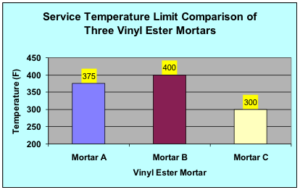
fig1

Figure 1 shows the temperature resistance of three different vinyl ester mortars. Reading the mortar manufacturer’s chemical resistance charts and product data sheets, the specifier finds each of the chemicals in her process tank is resistant to Mortar B. She sees that Mortar B has the highest temperature rating and chooses to specify Mortar B. It is the most expensive mortar, but it appears to be the best.

The specifier, confident in her choice of Mortar B, calls the mortar supplier for reassurance that she has made the right choice. After reviewing the application, an acidic-oxidizing process operating at 203°F, the mortar supplier offers to test the combination of chemicals at the specific operating temperature and measure strength retention over time. The data in Figure 2 is presented, and the specifier is convinced that in fact Mortar A is the best choice. As it turns out, Mortar A is less expensive than Mortar B, and it should be expected to last longer than Mortar B in this application.

Figure 2 – Comparison of Vinyl Ester Mortar Strength Retention in Acidic-Oxidizing Environment at 203°F
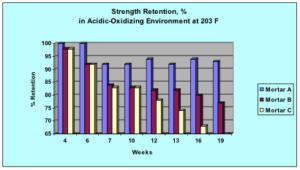
fig2

Later on, the process engineer is designing a different tank, which will operate at a cooler temperature than the first tank. Both applications involved oxidizing chemistry, and since the temperature in the second application is not as high, she again chooses Mortar A. Once again, she calls the mortar supplier for reassurance that she has made the right choice, and, once again, the mortar supplier offers to test the proposed chemical mix at the anticipated operating temperature. This time, the chemistry is alkaline-oxidizing at 160°F. The data in Figure 3 is presented, and the specifier’s preliminary mortar choice is again overturned. She clearly must choose Mortar C. Much to her pleasure, Mortar C is less expensive than Mortar A, and it can be expected to last longer than Mortar A in this application.

Figure 3 – Comparison of Vinyl Ester Mortar Strength Retention in Alkaline-Oxidizing Environment at 160°F
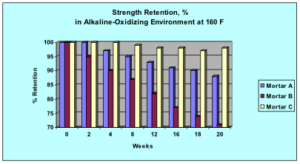
fig3

The moral of this story is that chemical resistance charts don’t tell the whole story. When there is a lot of money at stake—and when isn’t there?—it pays to make the best possible design decisions. When choosing materials for corrosion-resistant construction, material suppliers can provide invaluable guidance and technical support. It’s just not practical to capture every conceivable mixture of chemicals and temperatures in a chemical resistance chart, and differentiate the service life of each “recommended” material option. While a chart is a useful tool to get you pointed in the right direction, the best solutions are identified through consultation, and sometimes research and development partnership, with corrosion-resistant material suppliers.

Follow Us:


Our Products

  • Blackhawk
  • Corrosion Engineering
  • Ertech
  • Novocoat
  • Manufacturing Services
  • Sumter Coatings
  • Quality, Health and Safety Policy
  • Terms & Conditions

Contact Us

Contact Us - Armor
© 2026. All Right Reserved. Armor, Inc.
  • Home
  • Industry
  • Products
  • Resources
  • News
  • About
  • Contact
Scroll to top Scroll to top Scroll to top